Techmates at Czech Online Expo: How to Implement AI Transformation in Companies the Right Way
March 4, 2026


Author
At this year’s Czech Online Expo, we hosted a workshop focused on how to approach AI transformation systematically and with real impact on company operations. It was not about listing tools or presenting futuristic visions. It was about practical execution.
From our experience, most AI initiatives do not fail because of technology. They fail because of how they are implemented.
Technology Alone Is Not Enough
A common scenario looks like this. A company decides it wants AI, purchases tools, launches a pilot, and expects quick results. Without clear objectives, measurable ROI, and well structured processes, meaningful change rarely happens.
During the workshop, we highlighted an important distinction between traditional automation and the intelligent layer built on top of it. AI is not the same as automation. Automation follows predefined rules and executes fixed steps, while AI can work with text, context, and decision making. However, if the underlying processes are unclear or inefficient, no intelligent layer can fix them on its own.
Success does not start with a tool. It starts with a system.
Two Pillars of Successful Transformation
Every meaningful AI transformation stands on two equally important pillars. These pillars represent two different types of readiness inside a company. One is about people and capability. The other is about systems and execution. If one is missing, the transformation becomes unstable.
The Knowledge Pillar
This pillar is about people. It defines whether your organization truly understands how to work with AI in a responsible and effective way.
It means that:
- Teams understand how AI tools work and where their limitations lie
- They know how to structure prompts and formulate clear inputs
- Best practices are shared across the organization
- A culture of experimentation and continuous improvement is actively encouraged
Technology without capable people will not deliver long term impact.
The Technological Pillar
The technological pillar is about discipline, structure, and measurable execution. It ensures that AI initiatives are built on clearly defined processes rather than assumptions or trends.
In practice, this means that:
- Processes are mapped and inefficiencies are identified first
- ROI is evaluated before implementation
- Solutions are validated through pilot projects
- Only then is structured automation implemented at scale
Without this structure, companies often move too quickly from idea to implementation. They deploy tools without clarity on expected outcomes, success metrics, or integration into existing workflows. The result is fragmentation instead of transformation.
This structured approach significantly reduces the risk of AI becoming just another short term experiment without real business impact. It turns AI from an isolated initiative into a managed, scalable capability.
Practical Examples from Real Projects
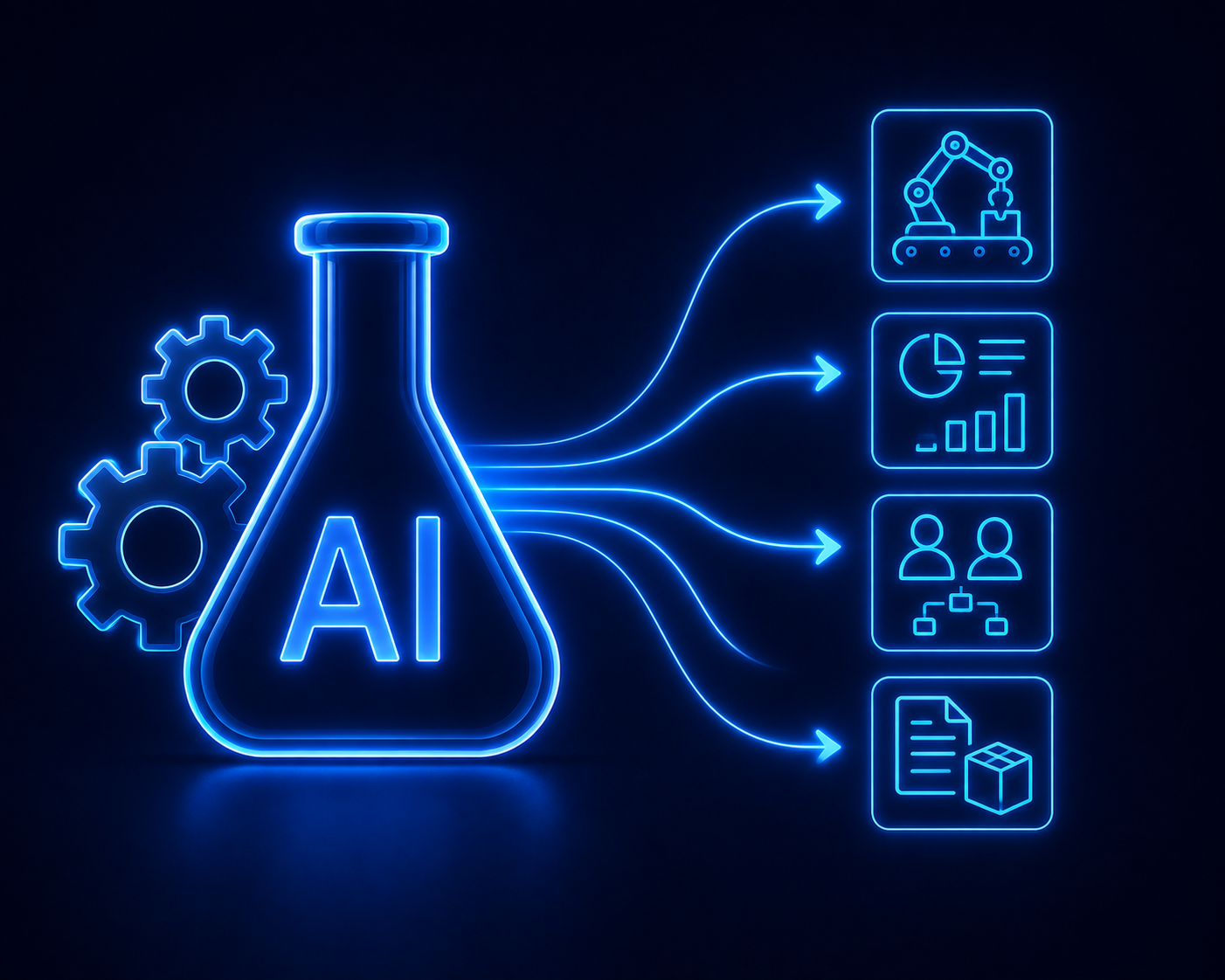
The workshop also included real world use cases where AI delivers measurable value. These included document processing, call transcription, sales support, data analysis and reporting.
Most of the discussion focused less on what AI can do and more on how to prioritize initiatives and calculate return on investment. That is exactly what companies need today.

What We Took Away from Czech Online Expo
It became clear that companies are no longer looking for another list of AI tools. They are looking for structure, realistic expectations and a clear roadmap.
AI transformation is not a one time project or a marketing experiment. It is a gradual shift in how a company operates. It requires strategic thinking, people development, and technological discipline.
Thank you to everyone who attended our workshop and contributed to the discussion. If you are exploring how to implement AI in your organization in a structured and ROI driven way, we would be happy to continue the conversation.