AI in 2027: Agents, New Skills, and Growing Pressure on Security
September 14, 2026

Author
2026 has shown that the next phase of artificial intelligence will not be driven solely by better models or a growing number of enterprise licenses.
Several topics that, until recently, were primarily the concern of technology teams are moving into the spotlight: AI agents, new employee skills, governance, cybersecurity, and changes in customer behavior.
The data published in 2026 cannot, of course, predict exactly what 2027 will look like. However, it points to several trends that could have an increasingly significant impact on how businesses operate.
AI agents bring a new level of automation to businesses
One of the most significant topics of 2027 may be AI agents.
Unlike a conventional AI assistant, which primarily answers questions or generates content, an agentic system can carry out individual steps within a workflow, interact with enterprise systems, or independently continue working on an assigned task.
Greater autonomy, however, also brings a greater need for control.
Deloitte surveyed 3,235 senior business and IT leaders across 24 countries in its global research. Only 21% of organizations had a mature governance model for autonomous AI agents, while 74% of respondents expected their company to use AI agents at least moderately by 2027.
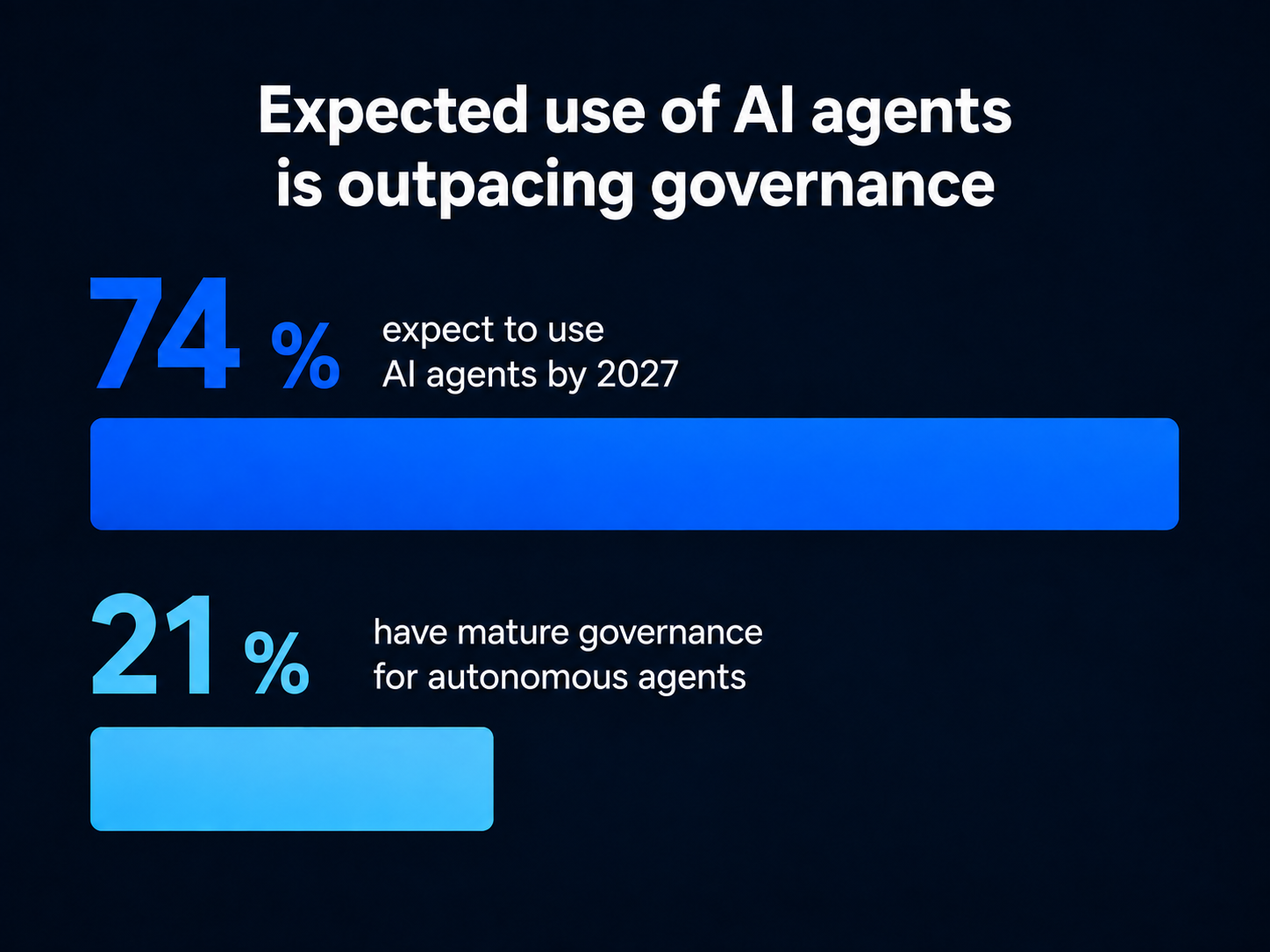
This gap suggests that adoption may advance faster than organizational readiness.
AI agents do not simply create new opportunities for AI automation. Companies must also determine which systems agents can access, which actions they can perform independently, when human approval is required, and how their activities can be reviewed afterward.
In 2027, the important question may therefore be not only what an AI agent can do, but also how safely a company can allow it to act.
AI skills are no longer just an IT concern
As artificial intelligence becomes more widely used, the skills companies look for in their employees are also changing.
The PwC 2026 Global AI Jobs Barometer analyzed more than one billion job advertisements across 27 countries and territories.
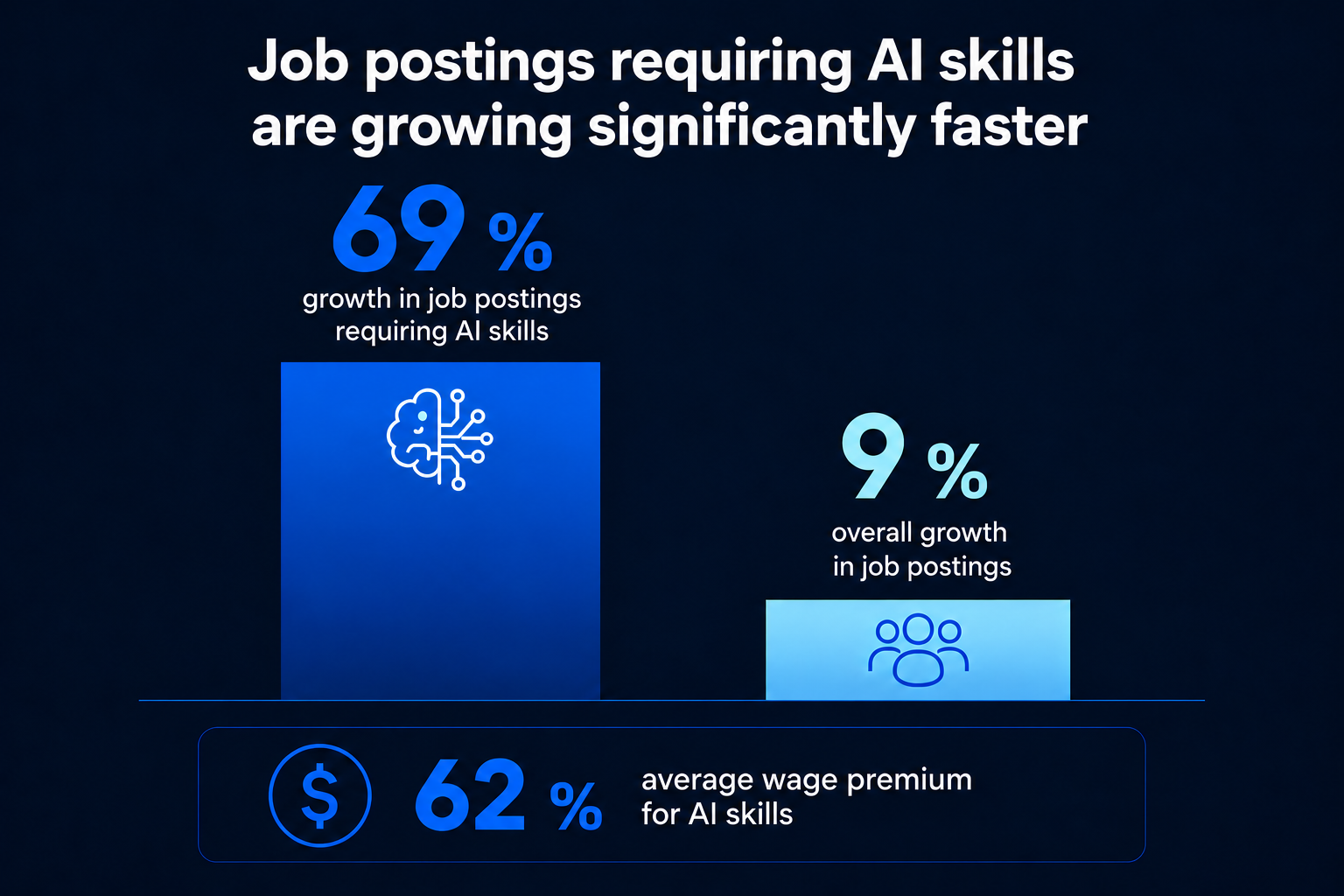
Since 2019, the number of job postings requiring specific AI skills has grown by 69%, while the total number of job postings has increased by 9%. The average wage premium associated with AI skills has also reached 62%.
More important than the numbers themselves, however, is the broader shift.
AI transformation is gradually becoming more than a project for a handful of specialists. Companies need people who can use artificial intelligence in marketing, sales, finance, operations, and customer service, and connect it to specific business processes.
Simply teaching employees how to use one particular tool is therefore not enough. As models evolve rapidly, the ability to define the right problem, work with AI outputs, and determine where the technology can genuinely create value may become just as important.

In 2027, the main question may therefore be not only “Which AI tool should we buy?”, but also “Who in our company can actually use it effectively?”
Your next customer may not shop alone
AI agents may gradually influence not only how companies work internally, but also how customers search for, compare, and purchase products.
Accenture surveyed 25,590 consumers across 16 countries. A total of 74% of respondents said they would trust a personal AI agent more than their best friend when making a purchase on their behalf.
However, this does not mean that customers are ready to hand over complete control to agents. Only 9% of respondents would currently allow an AI agent to complete a purchase entirely autonomously.
This distinction could be important for businesses. People may be open to having an agent help them choose and make decisions, while still wanting to retain control over the final step.
Today, companies primarily optimize their websites, product information, and offers for human users.
If customers increasingly use AI agents to search for and compare products, it may become important to ensure that prices, availability, specifications, and other information are also understandable to the systems helping customers make decisions.
The customer journey may therefore gradually gain a new participant: an AI agent between the business and the customer.
AI security is no longer just an IT problem
The more tasks AI systems perform, and the broader their access to enterprise data and systems becomes, the more important their security will be.
In its Global Cybersecurity Outlook 2026, the World Economic Forum surveyed 804 qualified respondents from 92 countries, including 316 CISOs, 105 CEOs, and 123 other C-level executives.
A total of 87% of respondents identified AI-related vulnerabilities as the fastest-growing cyber risk during 2025. The proportion of organizations systematically assessing the security of AI tools before deployment also increased significantly.
AI security is therefore becoming more than a purely technical issue.
As AI automation expands, security may determine which systems an agent can access, what it is allowed to do without human approval, how sensitive data is protected, and whether its activities can be audited afterward.
In some cases, security may even determine which AI solutions a company can safely deploy at all. In 2027, it may therefore become increasingly difficult to separate AI strategy from governance and cybersecurity.
2027 may still present an opportunity for Czech businesses
These changes are not relevant only to the largest technology companies.
For Central Europe, they may also represent an opportunity to close part of the current gap in AI adoption.
McKinsey estimates that AI could create €280–700 billion in economic value in Central Europe, while the region still lags Western Europe by 16% in enterprise AI adoption.
Czech data also shows that AI adoption is growing rapidly. In 2025, 17.6% of Czech companies with ten or more employees used at least one AI technology, nearly three times as many as in 2023. Among large enterprises, the share had already reached 54.1%.
Czech businesses may therefore still have an opportunity to gain a competitive advantage. However, that advantage is unlikely to come from access to AI models alone. The difference may lie in who can connect them to business processes sooner, develop the necessary skills, and manage governance and security at the same time.
What could make the difference in 2027?
AI is gradually moving from individual tools into the broader functioning of businesses.
In 2027, management attention may therefore increasingly shift from “Are we using AI?” to more practical questions:
- Where can AI agents take over part of the work, and where should humans remain in control?
- Do our people have the skills needed to work with AI?
- Are our governance and security practices ready for greater autonomy?
- How might the customer journey change if AI agents become involved in purchasing decisions?
- Which AI projects could actually create a competitive advantage for our business?
Better models will continue to matter.
However, an increasingly important difference may emerge between companies that simply have access to new AI capabilities and those that can actually integrate them into the way they work, sell, and make decisions.
One of the prerequisites remains the ability to move AI projects into stable, scalable operations. In our previous article, we explored how businesses can manage this transition in practice.