AI was expected to move from experimentation to real-world use in 2026. Did it?
September 8, 2026

Author
Artificial intelligence is no longer confined to a handful of experimental teams within companies. Its use has expanded rapidly, and attention is gradually shifting to another question: can businesses move AI from pilot projects into everyday operations?
The latest studies and data published in 2026 show that this transition is indeed taking place. At the same time, they confirm that a considerable gap remains between a working experiment and a solution that a company can use and scale over the long term.
Increasingly, the challenge is not just about the capabilities of the technology itself. Successful AI implementation also depends on data, integrations, processes, governance, and the readiness of the entire organization.
The journey from pilot to production is longer than it seems
Deloitte surveyed 3,235 senior business and IT leaders across 24 countries in its global State of AI in the Enterprise 2026 study. Only 25% of organizations had moved at least 40% of their AI experiments into production.
A pilot can demonstrate that a particular use case works technically. But real AI implementation begins when the solution is connected to actual data and systems, integrated into everyday processes, and supported by the organization for long-term operation. The biggest challenge may therefore not be coming up with another AI pilot, but moving successful ones into the everyday functioning of the business.
BMW provides a useful example. The company demonstrates how an advanced pilot can operate directly in a real manufacturing environment. Its GenAI4Q system at the Regensburg plant uses AI to generate recommendations for quality inspections during vehicle assembly. Although BMW still officially describes it as a pilot project, the system works with real production data and generates individualized inspection recommendations for approximately 1,400 vehicles produced each day.

Using AI is not the same as transforming a business
Using individual AI tools does not necessarily mean changing the way a company operates at a deeper level.
Data published in 2026 shows that many organizations primarily use artificial intelligence to improve their existing ways of working. Some companies, however, are already redesigning key processes around AI or using it to support a deeper transformation of their business.
The distinction matters.
An individual AI solution may save an employee time or simplify a specific task. But broader value emerges when the technology is connected to workflows, business systems, and decision-making processes. This is where the use of individual tools begins to evolve into genuine AI transformation.
Data may be one of the biggest barriers
A particularly significant gap can be seen in the readiness of enterprise data.
Accenture analyzed 2,000 companies across 15 countries and nine industries. Most respondents reported that their organizations had moved beyond the pilot stage or begun coordinated deployment of advanced AI.
Yet only 7% of companies had reached the level of data readiness needed to scale generative, agentic, and physical AI.
This points to a fundamental challenge: companies’ ambitions may be advancing faster than their data readiness.
The obstacle is not necessarily the amount of information available. More often, it is data fragmented across different systems, poor data quality, missing context, or unclear access rules. As AI solutions scale, these shortcomings become much more apparent.
A better model cannot solve these problems on its own.
This is particularly important with the emergence of agentic AI. Unlike conventional AI assistants, which primarily generate answers or content, agentic systems can independently carry out steps within business processes. This makes high-quality data, properly configured access permissions, and clear governance rules even more important.
As AI automation expands, the deciding factor will therefore not only be what a model can do, but also which data it can access and how securely the entire solution is connected to other enterprise systems.
Scaling is not just a technology challenge
A similar picture emerges from Capgemini’s research involving 1,505 managers at director level and above from large companies across 15 industries.
Respondents identified leadership support, governance and ethical frameworks, and scalable data infrastructure among the key conditions for successful AI scaling.
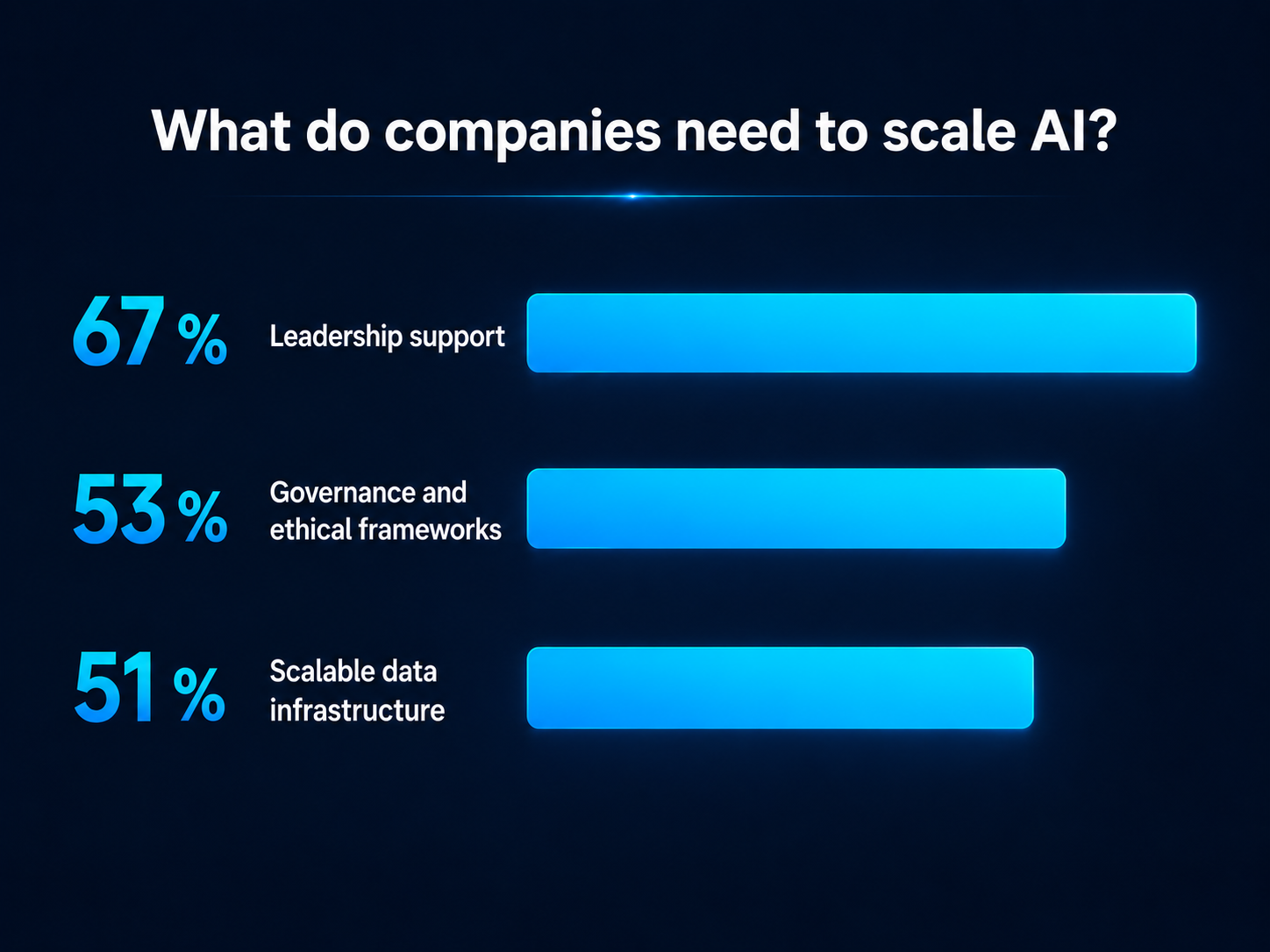
Technology is therefore only one part of the equation.
A company may have a high-quality AI solution and a promising use case, but if it is unclear who is responsible for it, how processes should change, or how its use will be governed, the project can quickly stall when moving to a larger scale.
The gap is also visible between the readiness of individuals and that of organizations.
McKinsey surveyed 750 employees who use AI, while organizational readiness was assessed by 608 leaders. A total of 70% of respondents felt personally ready to work with AI, whereas only 27% of leaders considered their organizations ready for the changes required by an agentic future.

Simply purchasing licenses or training employees is therefore not enough. Workflows, roles, responsibilities, and decision-making processes must also evolve alongside AI.
2027 may be about the ability to bring AI into everyday operations
The evidence from 2026 shows that companies are indeed moving beyond experimentation.
The greatest difference, however, may emerge in the next stage.
More organizations will gain access to high-quality AI models. The technology itself may therefore not be what sets companies apart. More important may be the ability to select the right projects, prepare the necessary data and processes, and then operate those solutions securely at a larger scale.
For management, this may mean placing greater emphasis on three things:
- Selecting pilots based on whether they have a clear path to real-world AI implementation.
- Addressing data, integrations, and accountability before scaling.
- Measuring actual usage and impact on processes, rather than the number of experiments created.
2027 may therefore not be about who launches the most new AI projects. What matters more may be who can take the right ones from experimentation into the everyday functioning of the business. The ability to bring AI into real-world operations is only one part of the equation.
Equally important is whether these projects actually deliver measurable value to the company. In our previous article, we explored the real value companies are gaining from their growing investments in AI.