How Much Will AI Cost in 2027? The Model Price Is Only Part of the Bill
September 24, 2026

Author
The cost of artificial intelligence is often reduced to a licence, subscription fee, or the price of a specific model. In a business environment, however, the real bill starts to take shape once AI is connected to data, systems, and everyday processes.
Beyond the model itself, costs can include integrations, infrastructure, operations, monitoring, security, and human oversight. And as artificial intelligence moves from experimentation into everyday business use, understanding the true cost of an AI solution becomes increasingly important.
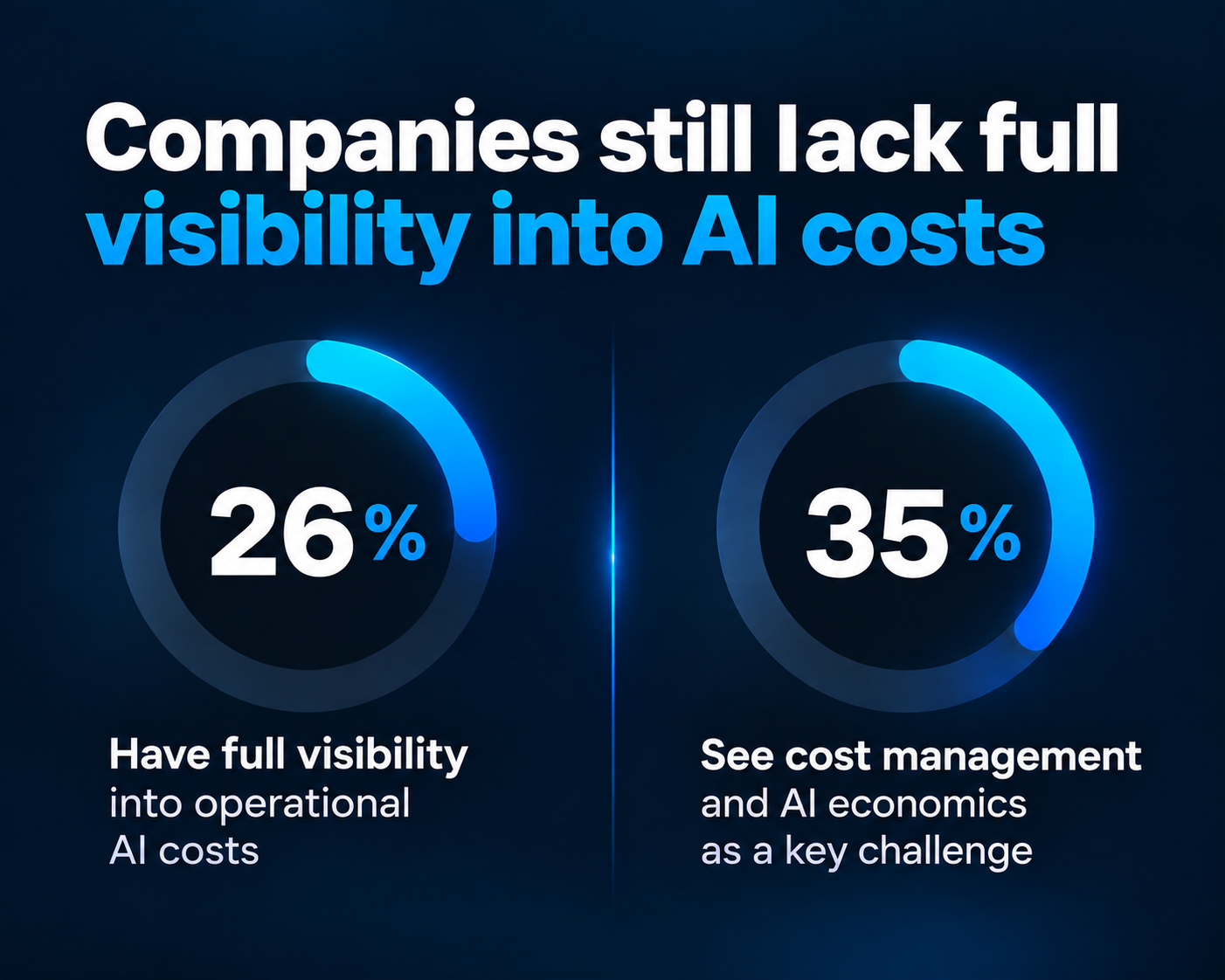
According to the KPMG AI Quarterly Pulse Survey, only 26% of organisations have full real-time visibility into the cost of operating AI at scale. At the same time, 35% of respondents cite AI cost management and understanding AI economics as a barrier. The survey included 204 US-based C-suite and business leaders from companies with annual revenue of at least $1 billion.
In 2027, the key question may therefore no longer be just which model to choose, but whether operating it at scale makes economic sense.
How Much Does AI Cost for a Business? There Is No Single Price
A simple chatbot has a very different cost structure from AI-powered document automation or an AI agent connected to CRM, ERP, and other business systems.
Yet all of them may use the same or a similar underlying model.
That is why the price of the model is not the same as the price of the entire AI solution. When implementing artificial intelligence in a business, costs can include APIs, data preparation, integrations, infrastructure, monitoring, security, human oversight, and ongoing maintenance.
For management, it may therefore be more useful to ask not only:
“How much does this AI tool cost?”
but rather:
“How much does it cost to use it in our actual process?”
The Cheapest AI Model Does Not Necessarily Mean the Cheapest Solution
A cheaper model may require more retries, more frequent human intervention, or produce more outputs that need to be corrected. At the same time, using the most powerful model for every simple task can be unnecessarily expensive.
AI implementation is therefore increasingly about finding the right combination of quality, speed, and cost for a specific use case. A different model may make sense for basic document classification than for complex analysis or decision-making processes.
Instead of asking “Which model is best?”, a more useful question may be:
Which model is good enough for this particular process, and at what cost?
A Pilot Can Be Cheap. Real-World Operations May Not Be
During the pilot stage, an AI system may work with only a few users and a limited amount of data. Outputs can be reviewed manually and individual errors handled one by one. Once the solution starts to scale, everything multiplies. More users mean more interactions, greater model consumption, higher integration and infrastructure requirements, and often more monitoring and oversight.
A project that looks economically attractive during a pilot can therefore behave very differently at larger scale.
In 2027, the focus may increasingly shift from asking whether an AI process works to asking whether it still makes economic sense in real-world operations.
AI Investment Is Growing, but Reality May Not Match Earlier Plans
A significant amount of money continues to flow into artificial intelligence. At the same time, earlier budget expectations do not always match the spending levels companies subsequently report.
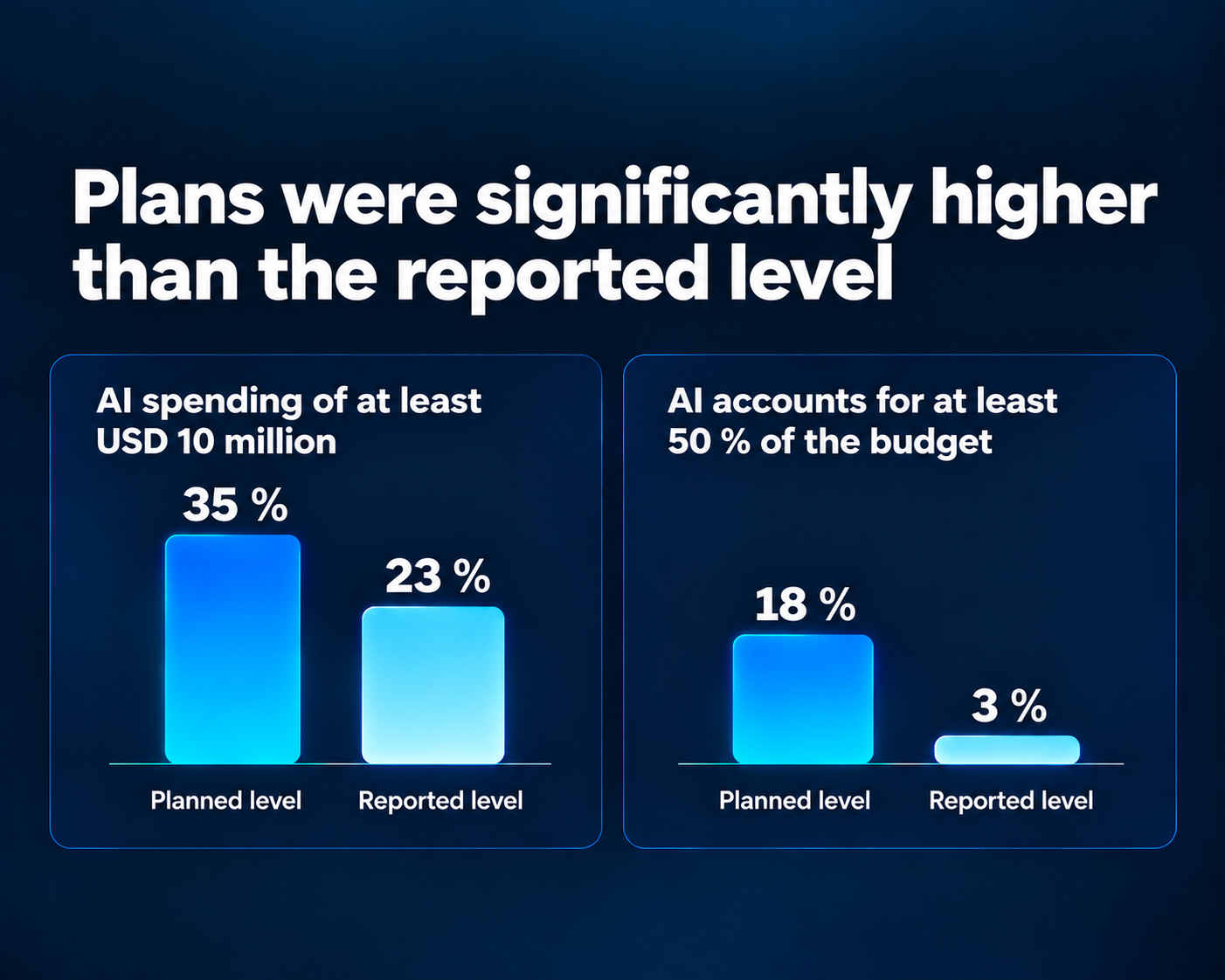
In a 2025 EY survey wave, 35% of senior executives expected their organisation to be spending at least $10 million on AI by this point. In the 2026 survey wave, 23% of respondents reported spending at that level.
The difference was even more pronounced at the highest budget levels. While 18% had previously expected AI to account for at least half of their total budget, only 3% reported this level in the following survey wave.
It is important to note that these were two separate EY survey waves, not the same companies being tracked over time. The data therefore does not show that specific organisations reduced their budgets. Rather, it highlights the difference between earlier expectations and the spending levels subsequently reported by a new group of respondents.
This does not mean AI investment is no longer growing. It may instead suggest that as companies move from expectations to real-world deployment, they are becoming more selective about where the money goes.
The question may therefore gradually shift from “How much should we invest in AI?” to “Which AI projects are worth continuing to fund?”
AI Infrastructure May Play a Growing Role in the Cost
The cost of artificial intelligence is not created only inside the application itself.
According to Gartner’s 2026 forecast, worldwide AI spending is expected to reach approximately $2.6 trillion in 2026, up 47% year over year. AI infrastructure is expected to be the largest segment, accounting for more than 45% of total spending.
For most companies, this obviously does not mean operating their own data centre. But infrastructure sits behind the services they use and affects the price of compute, available capacity, and the economics of individual providers.
As AI usage grows, companies may therefore need to pay more attention to what level of model and infrastructure a particular task actually requires.
How Much Will AI Agents Cost?
AI agents introduce another variable.
A typical chatbot usually responds to a single request. An AI agent may retrieve data, use several tools, perform multiple actions across systems, and then verify the result.
One task no longer necessarily means one model call.
The more complex agentic AI automation becomes, the more important it will be to look at the economics of the entire workflow rather than simply the cost of a token or a single model call.
Greater autonomy also raises questions around responsibility, governance, and security. We explored what AI agents and other changes could mean for companies in 2027 in our previous article, AI in 2027: Agents, New Skills and Growing Pressure on Security.
Human Work Can Be a Hidden Cost
Not every cost appears on an AI provider’s pricing page.
f an employee still needs to review every output, correct it, or repeat part of the original process afterwards, the expected efficiency gains from AI can be significantly lower.
Human oversight is not a problem in itself. In many processes, it will remain necessary.
Companies therefore need to understand how much of the process is still performed by people and whether artificial intelligence is genuinely changing the way work is done or simply adding another step. This applies across industries, from manufacturing and logistics to finance, retail, and customer service, wherever AI becomes part of everyday operations.

AI ROI Will Become a More Concrete Topic in 2027
As AI moves into day-to-day operations, it may no longer be enough to know that a solution works technically. Management will increasingly need to know whether it works at a cost that makes long-term economic sense.
That is why AI ROI may become a much more concrete topic in 2027.
Not every hour saved automatically translates into financial value. Not every process needs the most powerful model. And not every successful pilot is worth scaling. Companies are therefore likely to look not only at what AI delivers, but also at what it costs to operate in practice and what they actually get in return.
Frequently Asked Questions About the Cost of AI
The cost of AI varies significantly depending on the specific solution, scale of use, and how it is operated. The questions below cover some of the most common issues companies face when assessing AI costs, ROI, and scaling.
How much does AI cost for a business?
It depends on the type of solution. In addition to licence or model costs, expenses may include integrations, infrastructure, data work, human oversight, monitoring, security, and maintenance.
How much does it cost to implement artificial intelligence in a business?
A simple AI tool and a solution connected to several enterprise systems have very different economics. Integration scope, usage volume, and operational requirements all play a major role.
How much does AI automation cost?
The price depends mainly on process complexity, the number of interactions, integrations, and the amount of human oversight required. At higher usage volumes, the economics may look very different from the pilot stage.
Is a cheaper AI model always better?
No. If it requires more retries, more frequent reviews, or more corrections, the total cost of the process may end up being higher than with a more expensive but more reliable model.
How can a company tell whether AI is worth the investment?
Price alone is not enough. It needs to be compared with the value the solution actually creates, while also monitoring whether the economics change as usage scales.
In practice, it therefore makes more sense to compare not only individual AI tools, but the total cost of running a process with and without AI. As AI adoption grows, this broader view will become increasingly important when deciding what to scale, adjust, or stop.
AI Costs Will Increasingly Be About Operations
The cost of AI in 2027 will not be only about the price of a model or a licence. What matters will be the entire operating environment around it, from integrations and infrastructure to monitoring, human oversight, and scaling.
Companies will therefore increasingly need to evaluate artificial intelligence not only by what it can do, but by how much long-term value it can create relative to its total cost and that may be one of the important shifts in 2027: spending less time asking how many AI tools a company uses, and more time asking which of them still make economic sense once they are running in real-world operations.