Where Is AI Investment Heading, and What Is It Actually Delivering for Companies in 2026?
September 2, 2026


Author
More and more money is flowing into artificial intelligence. But as budgets grow, another question is becoming increasingly important: what are companies actually getting in return for these investments?
The latest studies and data published in 2026 reveal an interesting contrast. Expectations remain high, investment continues to grow, and companies expect higher productivity and revenue. Yet there is still a significant gap between investment and the business value actually achieved.
At the same time, it is becoming clear that value from artificial intelligence is not created equally across companies. Some organizations are already able to turn AI into measurable results, while others remain focused on growing budgets and individual experiments.
More money continues to flow into AI
The scale of current investment is well illustrated by Stanford University’s AI Index 2026. Global corporate investment in artificial intelligence more than doubled in 2025, while private investment alone increased by 127.5%.

This growth is also reflected directly in corporate budgets. Organizations planned to increase the share of revenue invested in AI from approximately 0.8% in 2025 to 1.7% in 2026. That represents more than a twofold increase in a single year.
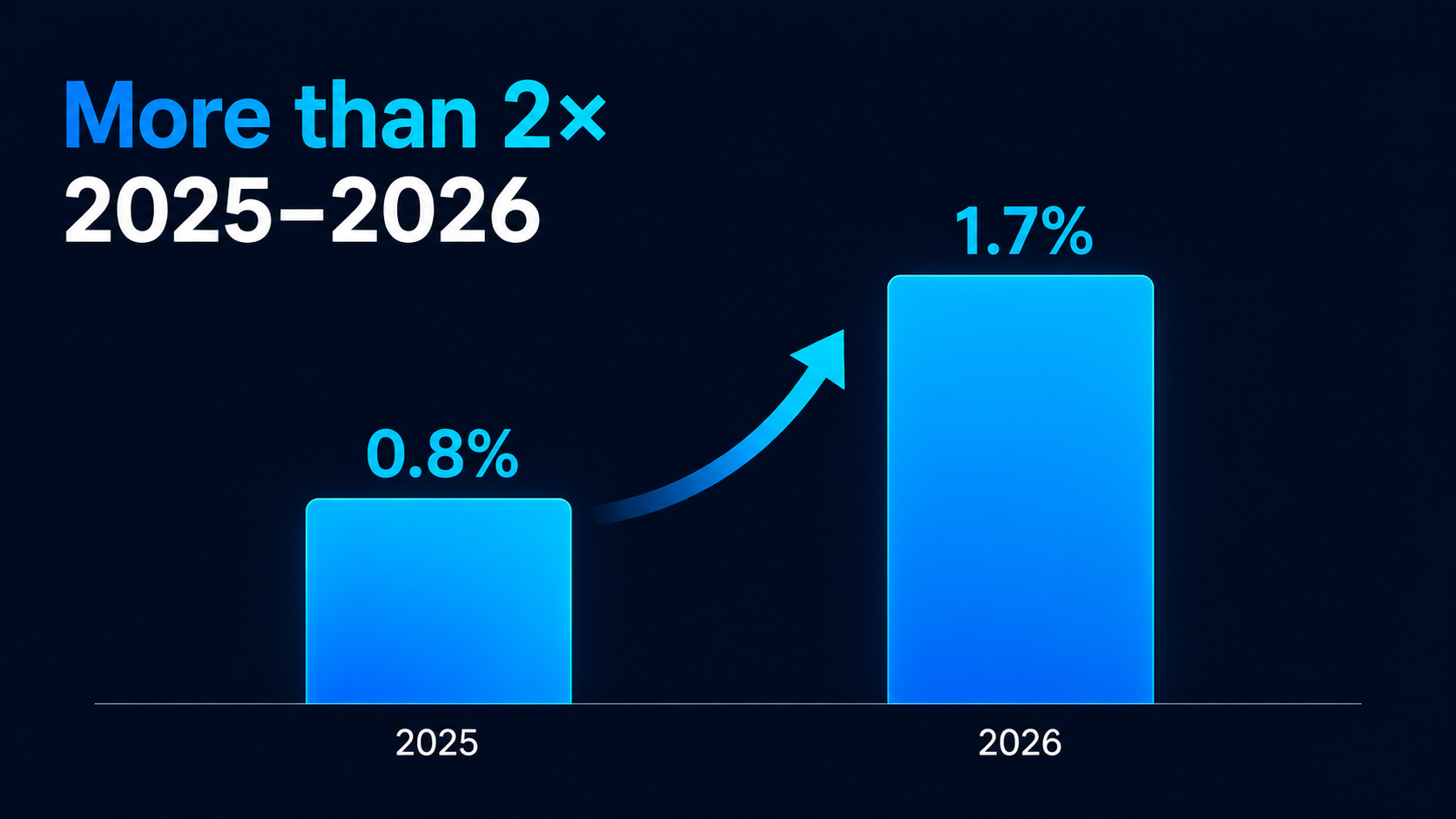
Growing budgets confirm that companies continue to believe in AI and are investing with the expectation that more significant returns will come later.
But as budgets grow, the gap between expectations and reality is becoming increasingly visible.
74% of companies expect AI to increase revenue. Only 20% are seeing it already
The gap shows how far expectations still remain ahead of measurable financial results.
This does not mean that artificial intelligence is failing to create value for companies. Rather, it suggests that many organizations still have a long way to go before their AI investments translate into tangible revenue growth.
A similar gap can be seen at the management level. 82% of C-level executives are increasing investment in AI, but only 23% say AI is already generating widespread and sustainable business value.
Initial budget plans do not always become reality either.
In one survey wave, 35% of senior executives expected their company to spend at least $10 million on AI. In the following survey, only 23% of respondents actually reported spending at that level. The gap was even larger for the most ambitious plans. 18% expected AI to account for at least half of their total budget. In reality, only 3% subsequently reported reaching that level.
A growing AI market therefore does not automatically mean that all original investment plans will materialize. Despite this, companies have not lost confidence in AI. 94% of organizations planned to continue investing even if AI failed to deliver a return during 2026.
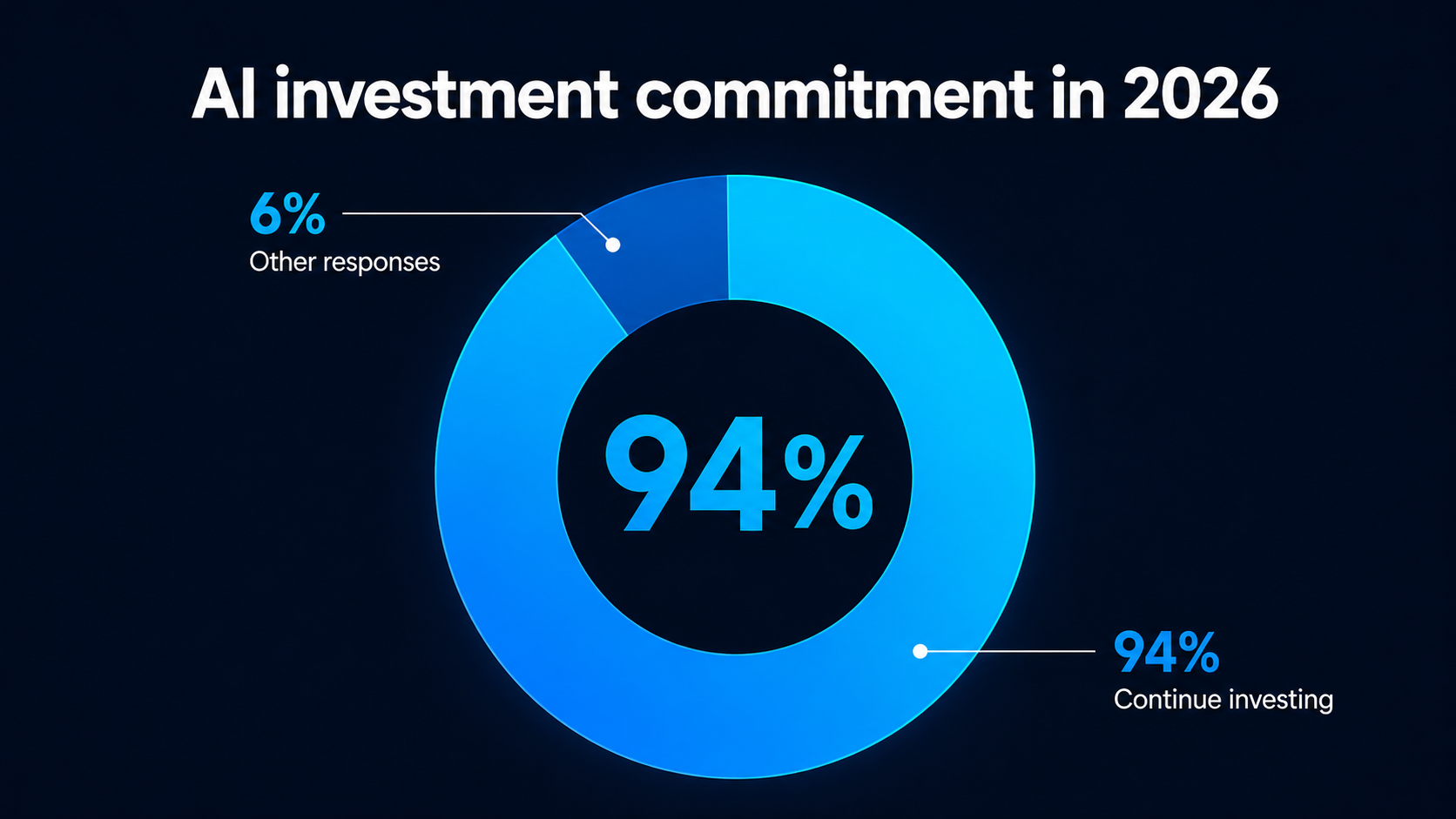
The current AI market therefore presents a rather unusual combination: budgets are growing, results are not yet convincing everywhere, but willingness to invest remains exceptionally high.
The value is there. But not everyone is capturing it equally
More important than the gap between investment and results is the difference between individual companies.
The PwC study "Want ROI from AI? Go for growth" shows that just 20% of companies capture 74% of the financial benefits associated with AI, measured through revenue growth and efficiency. Companies with the highest scores in what PwC calls AI fitness also achieved 7.2× higher AI-related financial performance than others.
Artificial intelligence therefore does not yet create the same value for every company that starts using the same tools or launches a few new projects.
Another study shows a similar relationship. Companies that had deployed AI across multiple functions reported almost twice the profit margins and more than five times the three-year ROIC of companies using AI in only a few departments.
It is important to note that this is a correlation, not proof that AI itself caused these results.
A similar pattern keeps emerging. The greatest value does not appear to come from isolated use of individual tools, but from the ability to connect AI with processes, data and business goals.
This is where individual use cases begin to turn into genuine AI transformation.
The first results are also visible in productivity
Financial results are not the only area where the impact of artificial intelligence is becoming measurable. Productivity growth between 2018 and 2025 was 40% higher among companies most exposed to AI than among those with the lowest exposure.
Again, the entire difference cannot automatically be attributed to artificial intelligence itself. It is an observed relationship between the level of AI exposure and productivity growth. These data are gradually changing the question management should be asking.
It is no longer enough to ask:
“Are we using AI?”
The more important question is becoming:
“Where is AI actually increasing our productivity, revenue or efficiency?”
The ability to answer this question may increasingly separate companies that simply use AI from those that actually create value from it.
What could change in 2027?
The data published in 2026 so far reveal a fairly clear contrast.
Investment in artificial intelligence continues to grow, and management expectations remain high. Companies are also willing to keep investing even without immediate returns. Yet only a portion of organizations are currently creating significant and sustainable value.
2027 may therefore bring a shift away from the question of how much to invest in AI toward a much more specific one:
What is the company actually getting back from these investments?
For management, this may mean greater focus on three things:
- clearly defining business KPIs before scaling a project
- prioritizing initiatives that have successfully moved into real-world operations and whose impact can be demonstrated
- reassessing or ending projects more quickly when they fail to deliver the expected results
The data already point in this direction: the actual impact on how a company operates will become more important than the number of AI tools, licenses or pilot projects it has.
Growing AI investment is an important signal, but money alone will not create a competitive advantage.
What will matter is which companies can turn their AI investments into real results.