



ORGUS · process intelligence by Techmates
A company without blind spots.
ORGUS uses AI to map how work runs in your company. You see the processes, find the bottlenecks and spot where to improve and automate.
What ORGUS does
ORGUS uses AI to map how work runs in your company.
See the processes and how they connect
Who does what, in which tool, who decides and who the work is handed to.
Find the bottlenecks that slow you down
Where work waits, where data is retyped by hand and where everything hangs on one person.
Spot where to improve and automate
Repeated manual work that automation or an AI agent can take over, and places where changing the process is enough.
Where work gets stuck
Ask five people. You get five answers.
And every one of them is true. Procedures describe how work is supposed to run. The real process is known by the people who do it every day – each their own part.
| How operations look in the overview | What mapping shows |
|---|---|
| Orders | Data from e-mails is retyped by hand, sometimes twice. |
| Approvals | An approval sits somewhere and nobody knows with whom. |
| Tools | Every department bought its own. |
| Handoffs | After approval the data is exported to Finance. Nobody sees the status in between. |
How ORGUS works
From conversations to a living map.
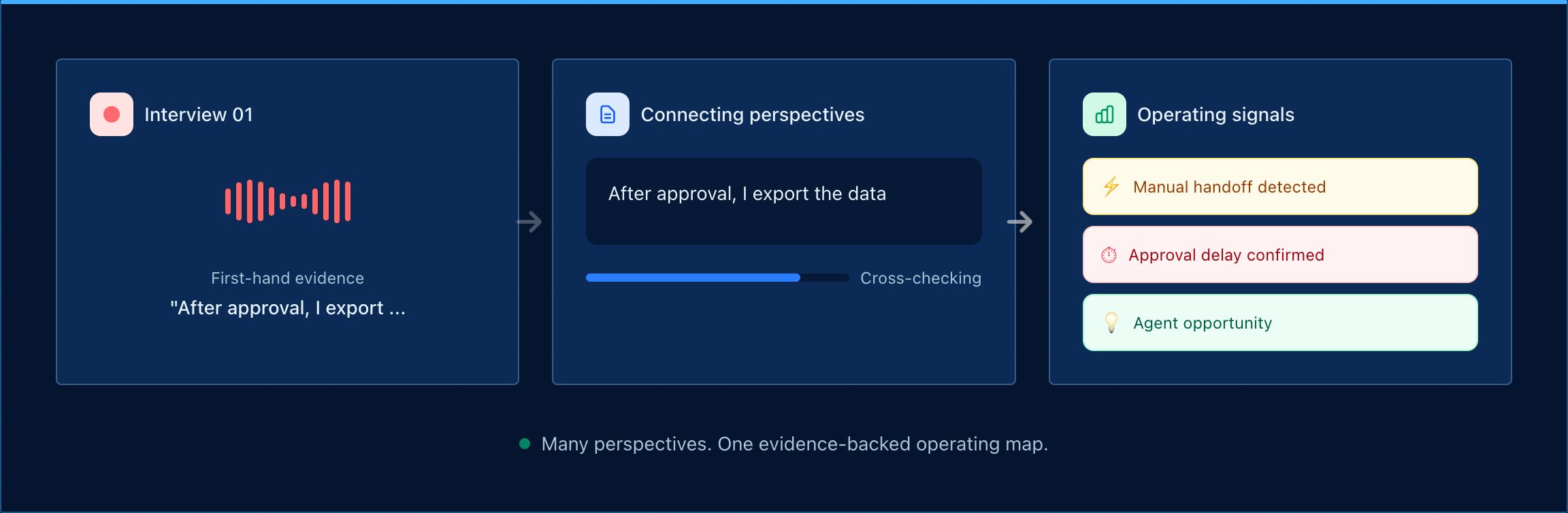
ORGUS builds the full picture from many focused, first-hand perspectives. By voice or text, at each participant’s own pace.
Set the scope
Choose the process, team, system or question you need to understand.
Collect perspectives
AI interviews each participant about the work they know directly.
Connect the evidence
ORGUS resolves overlaps and gaps into a process map, operating signals and prioritized opportunities.
What you do with the map
One operating map. Four ways to use it.
Capture operational knowledge once and use it wherever understanding the work matters.
Onboard with the real picture
Responsibilities, tools, decisions and handoffs, based on how experienced colleagues actually do the work.
Keep knowledge when people leave
Capture dependencies and hidden manual work before a colleague leaves and their context leaves with them.
Map processes as they really run
People, teams, tools, activities, decisions and handoffs between teams in an evidence-backed map.
Find opportunities for agents
Bottlenecks, overloaded roles and repeated manual work that automation or an AI agent can take over.
With the Techmates team
ORGUS interviews the people.We add the numbers and the order of changes.
A workshop shows how leadership sees the process. ORGUS interviews everyone involved in it, marks where people’s views diverge and compares reality with the target state.
You get a map of the current state, the losses in numbers and a plan of changes ordered by savings, effort and risk. You can stop at the map. Or we connect the systems and automation or an AI agent takes over the routine.
- to map one department; the whole order-to-cash flow in 4–8 weeks
- 2–3 weeks
Know the work before you change it.
Start with the people who do the work. Build a shared picture your next hire, handover and optimization can rely on.